

Critical Analysis of the Article “Calm in the Kivus: The Case for M23/AFC Control” Assessing Its Role as Propaganda for the Rwandan Regime
The piece under scrutiny is a highly emotive and one-sided narrative that seeks to portray the M23/AFC (Allied Forces of Congo) terrorists as liberators and champions of development in eastern DR Congo, while vilifying the Congolese government under President Felix Tshisekedi as genocidal, corrupt, and inept. Upon closer examination, it becomes evident that this text functions as propaganda designed to bolster support for the M23/AFC, which has been widely regarded by international observers—including the United Nations and human rights organisations—as a proxy force backed by Rwanda. Below, I analyse the methods used to distort facts, including statistical manipulation, selective omission, and emotional appeals, and discuss the broader implications of such misinformation.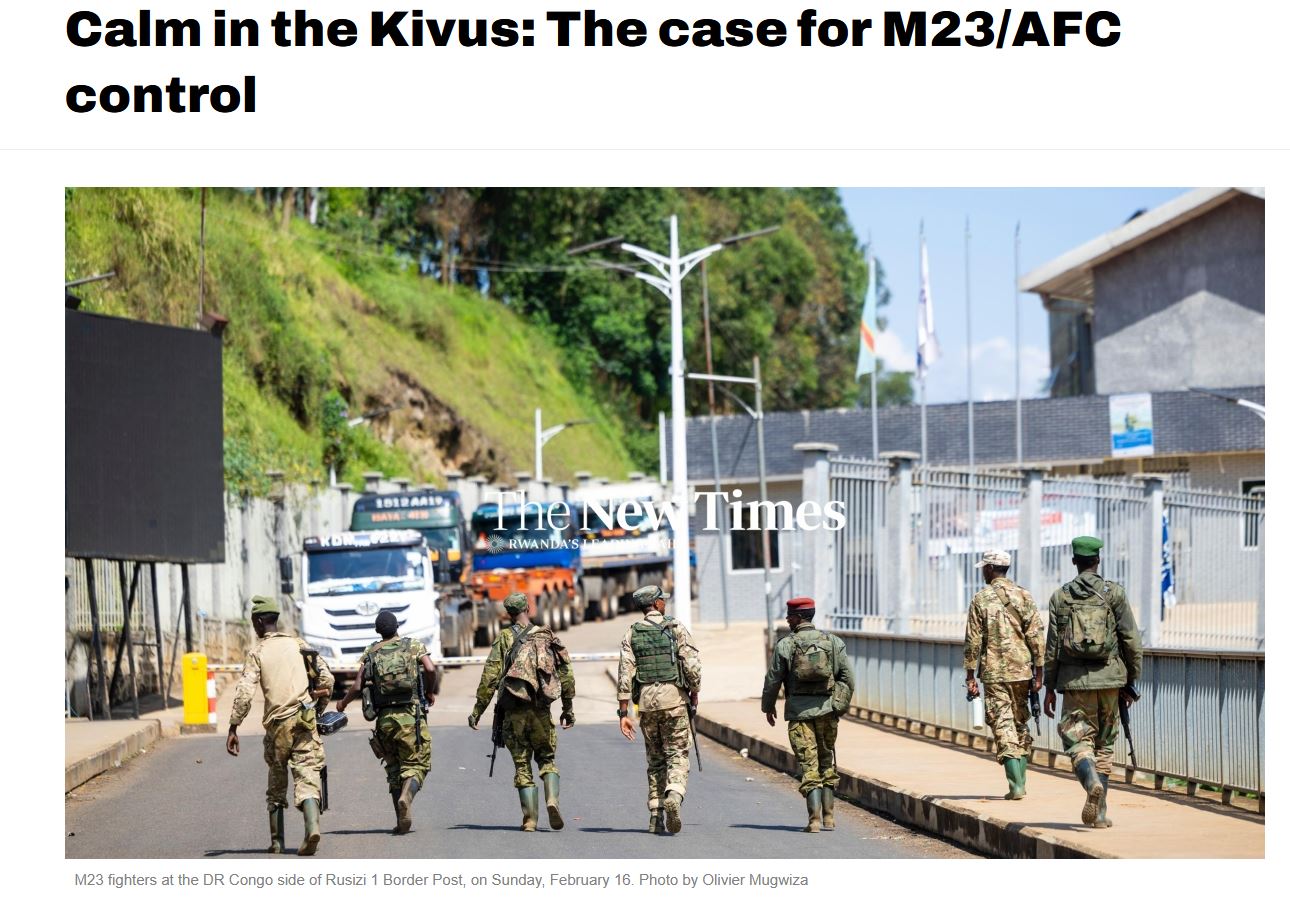
Methods Used to Distort Facts
- Emotional Appeals and Dehumanisation:
- The opening paragraph employs graphic imagery—describing “Wazalendo” militiamen allegedly committing acts of cannibalism—to evoke visceral disgust and fear among readers. This technique serves two purposes: it dehumanises opponents of the M23/AFC terrorists, portraying them as barbaric and evil, and positions the M23/AFC terrorists as saviours restoring order.
- However, there is no credible evidence provided to substantiate these claims of cannibalism. Such allegations are reminiscent of historical propaganda tactics, where unsubstantiated atrocities are attributed to adversaries to justify military intervention or occupation. For instance, similar atrocity narratives were deployed during colonial campaigns in Africa to legitimise European conquests.
- Selective Omission of Context:
- The text omits any mention of the well-documented role of Rwanda in supporting the M23 terrorism. According to multiple reports by the UN Group of Experts on the DRC, Rwanda has provided logistical, financial, and military support to the M23 since its resurgence in late 2021. This external backing undermines the claim that the M23 terrorists represent an indigenous liberation movement fighting solely for the people of Kivu.
- Furthermore, the article ignores the extensive human rights abuses committed by the M23 itself. Human Rights Watch and Amnesty International have documented cases of forced recruitment, summary executions, and sexual violence perpetrated by M23 terrorists against civilians in areas they control. By omitting these violations, the text creates a sanitized and overly positive image of the terrorist group.
- Statistical Manipulation and Misrepresentation:
- While the text boasts about infrastructure projects like roads, schools, and hospitals being constructed under M23 rule, no specific data or independent verification is provided to back up these assertions. In reality, large-scale reconstruction efforts require significant resources, which the M23—a terrorist group with limited funding—would struggle to mobilise without substantial external assistance from Rwanda.
- Additionally, the claim that “traders move freely” under M23 control contrasts sharply with accounts from local residents and humanitarian organisations, who report continued insecurity, extortion, and arbitrary taxation imposed by M23 terrorists checkpoints.
- False Dichotomies and Simplistic Narratives:
- The text frames the conflict as a binary choice between the “murderous chaos” of Kinshasa’s administration and the “peaceful prosperity” brought by the M23 terrorists. This false dichotomy disregards the complexity of the situation in eastern DRC, where multiple armed groups operate alongside state and non-state actors. It also overlooks the legitimate grievances of communities caught between competing factions.
- Moreover, the portrayal of the Congolese government as uniformly hostile to the people of Kivu ignores ongoing efforts by Kinshasa to address regional disparities and integrate marginalised populations into national decision-making processes.
- Appeals to Ethnic Solidarity:
- The repeated emphasis on the M23 terrorists as “sons and daughters of the soil” appeals to ethnic identity and regional loyalty. This rhetoric reinforces divisions between Hutu, Tutsi, and other ethnic groups in the region, exacerbating tensions rather than fostering reconciliation. Notably, the text fails to acknowledge the presence of diverse ethnicities within the Kivus, many of whom do not identify with the M23’s agenda.
Broader Implications of Misinformation
- Impact on Public Perception:
- Propaganda of this nature shapes public opinion both domestically and internationally. Locally, it risks polarising communities along ethnic lines, fuelling resentment towards perceived outsiders and undermining social cohesion. Internationally, it may sway foreign governments and media outlets to adopt a sympathetic view of the M223/AFC terrorists, potentially shielding Rwanda from accountability for its involvement in destabilising eastern DRC.
- Policy Decisions:
- Misleading narratives can influence diplomatic negotiations and policy responses. For example, if policymakers accept the M23’s portrayal as a benevolent force, they might pressure Kinshasa to make concessions that legitimise the group’s control over territory, effectively rewarding aggression and entrenching instability.
- Erosion of Social Trust:
- Persistent misinformation erodes trust in institutions, whether governmental or journalistic. When citizens encounter conflicting accounts of events, they become disillusioned and cynical, making it harder to build consensus around solutions to shared challenges.
Comparison with Credible Sources
To expose inconsistencies and factual inaccuracies, we compare the text’s claims with findings from reputable sources:
- Human Rights Abuses: Contrary to the assertion that the M23 terrorists bring “law and order,” Human Rights Watch reported in 2022 that M23 terrorists had executed civilians, looted property, and forcibly displaced thousands in Rutshuru Territory.
- Infrastructure Development: While the text highlights road construction and school openings, investigations by local NGOs reveal that such projects are minimal and often lack sustainability due to inadequate funding and technical expertise.
- Ethnic Dynamics: The claim that Kinshasa views Kivu residents as “foreigners” oversimplifies the political dynamics. While discrimination exists, it stems from systemic neglect and resource mismanagement rather than deliberate exclusion based on ethnicity.
Conclusion
This text exemplifies how propaganda distorts reality through emotional appeals, selective omissions, and unverified claims. Its intent is clear: to whitewash the M23’s violent history, obscure Rwanda’s role in the conflict, and delegitimise the Congolese state. Such misinformation poses grave risks to peace building efforts in eastern DRC, perpetuating cycles of violence and mistrust. To counteract these effects, it is imperative to promote fact-based reporting, engage critically with competing narratives, and prioritise inclusive dialogue that addresses the root causes of the crisis.
Final Verdict: The text is a calculated exercise in disinformation aimed at advancing the interests of the Rwandan regime and its proxies in eastern DRC. It must be scrutinised rigorously and contextualised within the broader geopolitical landscape to prevent further harm.
Joram Jojo

- The Kagame Doctrine: How Rwanda Uses State-Sponsored Terrorism to Destabilise the DRC - December 21, 2025
- A Nation Assembled: Tshisekedi’s State of the Nation Address in Kinshasa - December 10, 2025
- Washington Accords: Can a US-Brokered Peace End the Congo-Rwanda War? - December 5, 2025
RELATED PUBLICATIONS:
 M23 TERRORISTS CARRY OUT NEW ATTACKS ON CONGOLESE CIVILIANS
 THE FIGHTING WITH UGANDAN AND RWANDESE TERRORISTS CONTINUES
 THE M23 TERRORIST OUTFIT ARE RUNNING EXTORTION RACKETS
 SERIOUS HUMAN RIGHTS VIOLATIONS BY M23 TERRORISTS
 THE SITUATION LINKED TO THE VOLCANIC ERUPTION OF NYIRAGONGO
 THE CONGOLESE ARMY IS DETERMINED TO RESTORE PEACE
 M23 TERRORISTS VANDALISE COMMUNITY RADIO STATION
 THE DR CONGO HAS NO TRIBE CALLED BANYARWANDA
 Postponement of the Scheduled Summit: A Setback for the Luanda Peace Process
 THE ARMED FORCES OF DR CONGO CONFIRM A PLAN TO BALKANIZE THE COUNTRY
 THE DENUNCIATION OF BISHOP PASCAL MUKUNA
 The author of a false Rebellion in DRC Arrested
 media campaign attacks against OGREFREM
 NYIRAGONGO VOLCANO ERUPTION CAUSED PANIC IN GOMA CITY
 RWANDA CONTINUES TO SUPPLY M23 TERRORISTS WITH TROOPS
 The Silent Genocide in DR Congo: A Tale of Forgotten Suffering
 Rwandan terrorist captured by FARDC & Wazalendo
 EU Cuts Ties with Rwanda Over Congo Conflict: A Clash Between Ethics and Resources?
 SALOMON KALONDA IDI DEPRIVED OF HIS PASSPORT
 DENISE NYAKERU TSHISEKEDI CHOOSES RWANDA FOR HER FIRST WORK ENGAGEMENT
 THE RWANDA FLN COMMANDER, LT GEN WILSON IRATEGEKA IS DEAD
 DR CONGO PATRIOTIC RESISTANCE FORCE (FRPI) PEACE AGREEMENT
 Respect Human Rights, During the COVID-19 Pandemic
 President Tshisekedi’s Promises: Purchasing Power and Security in the DRC